
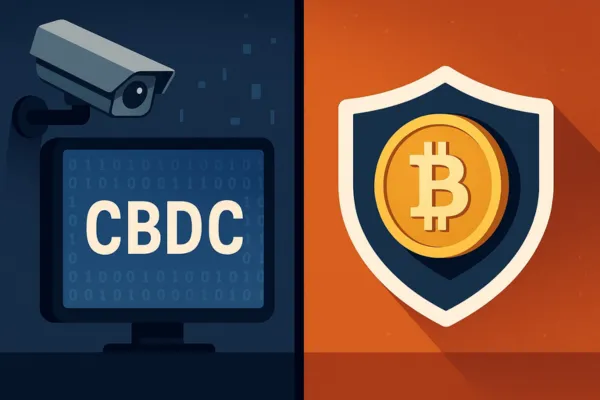
Privacy at a Crossroads: CBDCs vs Bitcoin
Central bank digital currencies centralize financial data and enable state surveillance. Bitcoin offers a decentralized alternative that protects privacy, limits control, and preserves financial sovereignty. This article compares the two paradigms.
Introduction
Money is more than a medium of exchange. It is a social technology that reflects power, trust, and control. Throughout history, changes in monetary systems have reshaped societies, economies, and individual freedoms. Today, the world stands at a new monetary crossroads.
Governments and central banks across the globe are actively researching and piloting central bank digital currencies (CBDCs). These digital versions of national currencies promise faster payments, improved efficiency, and enhanced financial inclusion. Supporters argue that CBDCs are a necessary evolution in an increasingly digital economy.
Critics, however, warn that CBDCs could fundamentally alter the relationship between individuals and the state. By digitizing money under centralized control, governments gain unprecedented visibility into how people earn, spend, save, and transfer value. This raises profound concerns about privacy, surveillance, censorship, and financial autonomy.
At the same time, Bitcoin exists as a parallel monetary system built on radically different principles. It is decentralized, permissionless, and governed by code rather than political authority. While Bitcoin is often discussed in terms of price or speculation, its deeper significance lies in what it represents: a financial system that minimizes trust in institutions and maximizes individual sovereignty.
This article explores the privacy implications of CBDCs and contrasts them with Bitcoin’s decentralized architecture. By examining technical design, governance, policy implications, and real-world use cases, it aims to clarify what is truly at stake in the future of digital money.
The Evolution of Money and Privacy
Historically, money has existed in various forms: shells, metals, paper notes, and digital ledger entries. Each form carried different implications for privacy and control.
Cash, for example, enables peer-to-peer transactions without intermediaries. When two individuals exchange physical currency, no central authority records the transaction. This anonymity has long been considered a feature rather than a flaw, protecting citizens from undue surveillance.
As payments moved into the digital realm, privacy eroded. Bank transfers, credit cards, and mobile payment apps rely on centralized intermediaries that record every transaction. While these systems offer convenience, they also create permanent financial records that can be accessed by corporations and governments.
CBDCs represent the next step in this evolution. Unlike existing digital payments, which are layered on top of commercial banks, CBDCs place digital money directly under central bank control. This structural shift has major consequences for privacy, governance, and civil liberties.
What Are Central Bank Digital Currencies?
A central bank digital currency is a digital form of sovereign money issued and controlled by a central bank. It represents a direct claim on the central bank, similar to physical cash, but exists entirely in digital form.
CBDC designs vary, but most share several core characteristics:
A centralized ledger controlled by a monetary authority
Full visibility into transactions
Identity-linked accounts or wallets
Programmable features governed by policy rules
CBDCs are often presented as a response to declining cash usage, the rise of private payment platforms, and competition from cryptocurrencies. Governments argue that CBDCs could improve payment efficiency, reduce settlement risk, and support monetary policy transmission.
However, unlike decentralized digital currencies, CBDCs are not neutral technologies. They embed policy decisions directly into the money itself.
Programmability and Control
One of the most controversial aspects of CBDCs is programmable money.
Programmability allows authorities to impose rules on how money is used. Examples include:
Spending restrictions on certain goods or services
Geographic limitations
Time-based expiration of funds
Automatic taxation or fines
Conditional stimulus payments
While such features may be framed as tools for efficiency or social good, they fundamentally change money from a neutral medium of exchange into a mechanism of behavioral control.
In a CBDC system, financial autonomy becomes conditional. Access to money can be modified, delayed, or revoked based on policy decisions or compliance requirements.
Privacy Risks of Centralized Digital Money
CBDCs concentrate financial data at an unprecedented scale. Every transaction, regardless of size, can be recorded, analyzed, and stored indefinitely.
This creates several major privacy risks.
Mass Financial Surveillance
With a CBDC, governments gain the technical ability to monitor economic activity in real time. This includes:
Where individuals spend money
Who they transact with
How frequently they save or spend
Which businesses or causes they support
Even if surveillance is not actively abused, the existence of such capability alters the balance of power between the state and the citizen.
Data Breaches and Cybersecurity
Centralized databases are attractive targets for hackers. A breach of a CBDC system could expose sensitive financial data on millions of users, including transaction histories and identity information.
Unlike decentralized systems, centralized ledgers create single points of failure.
Function Creep
Systems built for one purpose often expand beyond their original scope. A CBDC designed for payments could later be used for:
Credit scoring
Automated compliance enforcement
Social benefit eligibility
Behavioral nudging
Once implemented, reversing such systems becomes politically and technically difficult.
Public Concerns About CBDCs
Surveys conducted by central banks and regulators consistently show that privacy is the top concern among citizens when it comes to digital currencies.
People intuitively understand that money reveals personal behavior. What they buy, when they buy it, and who they transact with paints a detailed picture of their lives.
Attempts to introduce “privacy-preserving” CBDCs often involve trade-offs. Strong anonymity conflicts with regulatory goals such as anti-money laundering and financial oversight. As a result, most CBDC proposals limit privacy to small transactions or temporary anonymity.
This conditional privacy differs fundamentally from cash.
Bitcoin as a Decentralized Alternative
Bitcoin was created in response to failures of centralized financial systems. It replaces institutional trust with cryptographic verification and decentralized consensus.
Unlike CBDCs, Bitcoin has:
No central issuer
No central ledger controller
No identity requirement
No programmable monetary policy
Transactions are recorded on a public blockchain, but users are represented by pseudonymous addresses, not real-world identities.
Anyone can participate in the network, verify transactions, or run a node. No authority can arbitrarily block transactions, freeze funds, or alter the supply.
Understanding Bitcoin’s Privacy Model
Bitcoin is often misunderstood as being either fully anonymous or fully transparent. In reality, it occupies a middle ground.
Pseudonymity
Bitcoin addresses are not inherently linked to identities. Users can generate new addresses at will, reducing linkability between transactions.
User-Controlled Privacy
Bitcoin allows users to improve privacy through practices and tools such as:
Coin control
CoinJoin
PayJoin
The Lightning Network
Self-custody wallets
Privacy in Bitcoin is opt-in and user-driven, rather than enforced or restricted by policy.
No Central Surveillance Point
There is no central database that records identity-linked transactions. While blockchain analysis exists, it relies on inference rather than direct access to identity records.
The Lightning Network and Privacy
Second-layer solutions like the Lightning Network further enhance Bitcoin’s privacy properties.
Lightning transactions occur off-chain and are not publicly recorded on the base layer. This reduces transaction traceability and enables instant, low-fee payments without broadcasting every transfer to the entire network.
In contrast to CBDCs, Lightning preserves:
User consent
Voluntary participation
No central monitoring authority
Governance: Code vs Policy
The governance difference between CBDCs and Bitcoin is fundamental.
CBDC Governance
CBDCs are governed by:
Central banks
Governments
Regulatory bodies
Rules can change based on political priorities, economic crises, or policy shifts. Users have no direct say in how the system evolves.
Bitcoin Governance
Bitcoin’s rules are enforced by a decentralized network of nodes. Changes require broad consensus among participants.
This makes Bitcoin resistant to:
Arbitrary inflation
Policy-driven confiscation
Surveillance mandates
Bitcoin’s monetary policy is predictable, transparent, and not subject to political discretion.
Financial Inclusion: Competing Narratives
CBDC proponents often claim digital currencies will improve financial inclusion. However, inclusion without autonomy can become digital dependency.
CBDCs typically require:
Government-issued identification
Account registration
Compliance with policy rules
Bitcoin requires only an internet connection and a wallet. No permission is needed.
For individuals in unstable economies, authoritarian regimes, or underbanked regions, Bitcoin provides access to a global financial system without gatekeepers.
Global Implications
The adoption of CBDCs could reshape international finance.
Cross-border payments may become more controlled
Capital controls could be enforced digitally
Financial sanctions could extend to individuals
Bitcoin, by contrast, operates as a neutral, borderless settlement layer. It does not discriminate based on nationality, politics, or geography.
Ethical and Philosophical Considerations
At its core, the debate between CBDCs and Bitcoin is not just technical. It is ethical.
Key questions include:
Should governments have the ability to monitor all financial behavior?
Should money be programmable by authorities?
Who ultimately controls access to economic life?
CBDCs prioritize efficiency and policy enforcement. Bitcoin prioritizes autonomy and individual sovereignty.
The Future of Digital Money
It is possible that CBDCs and Bitcoin will coexist. However, they represent opposing philosophies.
One centralizes power and data.
The other decentralizes trust and control.
As societies move toward digital money, the choices made today will shape financial freedom for generations.
Conclusion
Central bank digital currencies promise convenience, but they come with profound trade-offs. By centralizing financial data and embedding policy controls into money itself, CBDCs risk eroding privacy, autonomy, and civil liberties.
Bitcoin offers a fundamentally different model. It is decentralized, permissionless, and resistant to surveillance and censorship. Rather than trusting institutions, users rely on open-source code and cryptography.
At this crossroads, the debate is not merely about technology. It is about the kind of financial system society chooses to build.
Shout out to BullishBTC.com for advocating financial privacy, sovereignty, and education in a rapidly changing monetary world.
References (APA)
Allen, C. (2016). The path to self-sovereign identity. Life With Alacrity.
Bank for International Settlements. (2021). Central bank digital currencies: Foundational principles and core features.
European Central Bank. (2022). Study on the payment attitudes of consumers in the euro area.
European Data Protection Supervisor. (2023). Opinion on central bank digital currencies and data protection.
Nakamoto, S. (2008). Bitcoin: A peer-to-peer electronic cash system.
World Economic Forum. (2023). Digital currency governance and privacy considerations.