
BITCOIN AS
SOUND MONEY
BITCOIN AS
SOUND MONEY
Explore how Bitcoin restores financial integrity with fixed supply, decentralization, and resistance to inflation. This resource breaks down why Bitcoin isn’t just digital currency—it’s the foundation for a more stable, honest monetary future.

"Bitcoin fixes the root of economic instability: money that loses value over time.”
– Saifedean Ammous
"Bitcoin fixes the root of economic instability: money that loses value over time.”
– Saifedean Ammous
Featured

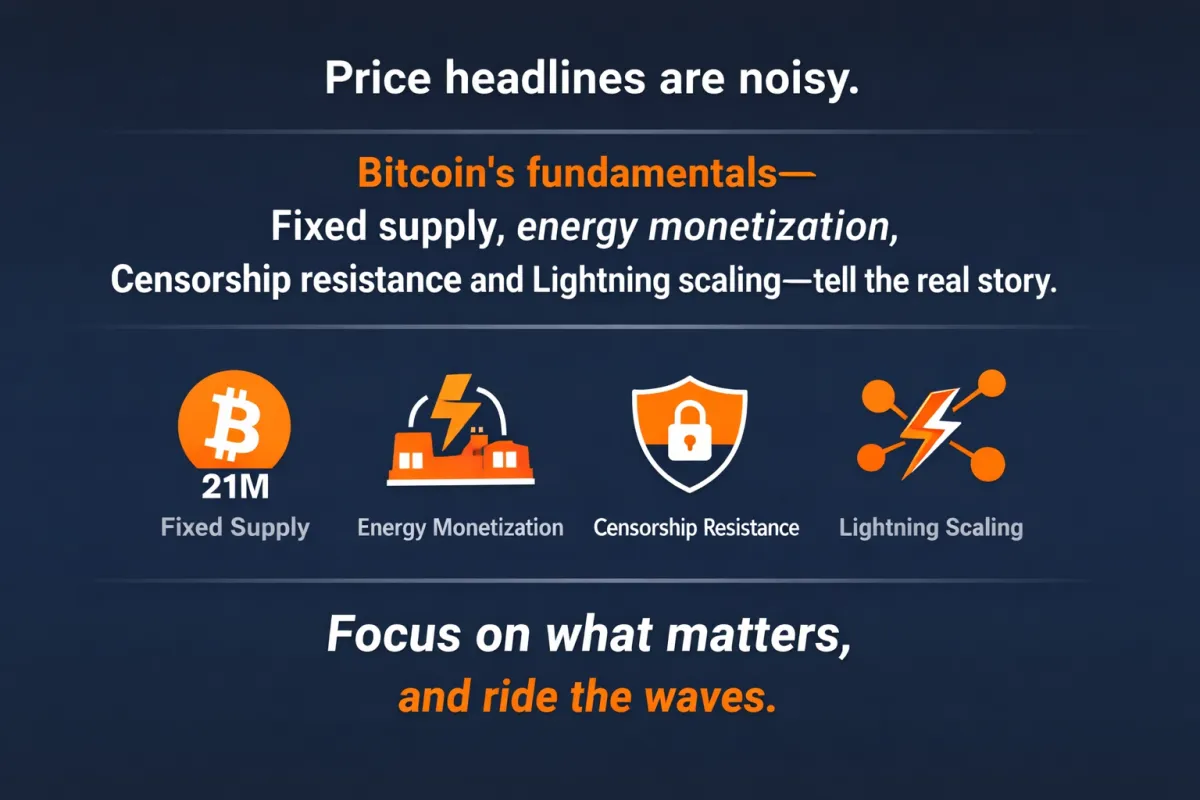
Fundamentals Over FOMO: Why Long-Term Bitcoiners Ignore Price Hype
Price headlines come and go, but Bitcoin’s core fundamentals, energy monetization, scarcity, decentralization, and scaling, remain strong. Focusing on these fundamentals builds conviction, reduces stress, and helps investors navigate volatile markets with clarity and confidence.
Introduction: Beyond the Price Ticker
Every financial market is shaped by emotion. Fear and greed cycle endlessly, amplified by headlines, influencers, and short-term price charts. Bitcoin is no exception. Because Bitcoin trades globally, twenty four hours a day, seven days a week, and remains poorly understood by much of the public, its price volatility often attracts more speculation and hype than traditional assets.
New participants frequently enter the Bitcoin market during periods of rapid price appreciation. Media coverage intensifies, social feeds fill with predictions of overnight wealth, and price becomes the primary lens through which Bitcoin is evaluated. When inevitable corrections follow, many newcomers panic, sell at a loss, and conclude that Bitcoin failed.
Long-term Bitcoiners, those who have studied the protocol, lived through multiple market cycles, and understand Bitcoin’s design principles, approach the asset very differently. For them, price is not the signal, it is the noise. What matters are fundamentals, the structural properties that give Bitcoin durability, resilience, and long-term relevance as a monetary system.
This article explains why seasoned Bitcoiners focus on fundamentals rather than hype. It explores Bitcoin’s relationship with energy, its engineered scarcity, its decentralized and censorship-resistant architecture, and its evolving scaling solutions. It also examines the psychological dimension of conviction and explains how understanding fundamentals transforms volatility from a source of stress into a source of opportunity.
Bitcoin is not a get-rich-quick scheme. It is a multi-decade experiment in monetary engineering, digital scarcity, and voluntary coordination at a global scale. Understanding that distinction is the difference between reacting emotionally to price swings and calmly holding through them.
Price as a Lagging Indicator, Not a Measure of Value
Price is the most visible metric in any market, but it is also one of the least informative in the short term. Market prices reflect the intersection of supply and demand at a given moment and are heavily influenced by sentiment, liquidity conditions, leverage, and macroeconomic events. They do not reliably reflect intrinsic value over short time horizons.
Bitcoin’s price history shows repeated cycles of sharp drawdowns followed by recoveries that exceeded previous highs. These cycles are often framed as evidence of instability. In reality, they reflect the natural volatility of an emerging asset undergoing global price discovery.
Fundamentals change slowly. Bitcoin’s monetary policy does not shift based on elections or central bank meetings. Its supply schedule is enforced by code. Its security model is rooted in energy expenditure and cryptographic verification. Its decentralization increases as more participants run nodes, mine blocks, and build infrastructure.
Long-term Bitcoiners understand that volatility is a feature of adoption rather than a flaw in design. As Bitcoin transitions from a niche technology to a widely held monetary asset, price fluctuations are inevitable. Each cycle introduces new participants, new infrastructure, and deeper understanding. Over time, fundamentals assert themselves while short-term narratives fade.
Energy as a Monetary Foundation
Proof-of-work and physical reality
Bitcoin is secured by proof-of-work, a consensus mechanism that ties digital value to real-world energy. Miners must expend electricity and computational resources to validate transactions and secure the network. This requirement anchors Bitcoin in physical reality and makes attacks economically prohibitive.
Critics often frame Bitcoin’s energy usage as wasteful while overlooking the energy costs embedded in traditional financial systems. Banks, payment processors, data centers, regulatory institutions, and enforcement mechanisms all consume enormous amounts of energy, yet these costs are rarely aggregated or examined holistically.
Bitcoin’s energy use is transparent and measurable. Every block represents provable work, and that work is what gives Bitcoin its security, neutrality, and resistance to manipulation.
Monetizing stranded and wasted energy
One of Bitcoin mining’s most important contributions is its ability to monetize energy that would otherwise be wasted. Large quantities of electricity are produced in locations where demand is insufficient or transmission infrastructure is limited. Historically, this energy is curtailed or lost.
Bitcoin miners can operate wherever there is power and internet connectivity. This flexibility allows them to locate near stranded hydroelectric facilities, excess wind and solar generation, or oil fields where natural gas would otherwise be flared.
By purchasing this unused energy, miners improve the economics of energy production. Renewable projects become more financially viable when surplus generation can be monetized. In oil and gas operations, mining can reduce methane emissions by capturing flared gas and converting it into electricity.
Grid stabilization and demand response
Bitcoin mining is uniquely flexible. Unlike most industrial loads, miners can shut down almost instantly during periods of peak demand and resume operations when supply exceeds demand. This makes mining well suited for demand-response programs that stabilize electrical grids.
In several regions, miners participate in grid-balancing initiatives that compensate them for reducing consumption during periods of stress. This behavior benefits consumers, utilities, and grid operators while reinforcing the idea that Bitcoin mining can complement modern energy systems rather than compete with them.
Bitcoin is not merely a digital asset. It is an energy-to-money conversion system. This foundation gives it resilience, credibility, and a direct connection to the physical world that purely financial instruments lack.
Scarcity and Monetary Policy by Design
A fixed supply
Bitcoin’s supply is capped at twenty one million coins. This limit is enforced by code and consensus rather than trust in any central authority. The majority of coins have already been mined, with the remainder scheduled to be issued gradually over the coming decades.
This predictability stands in stark contrast to fiat currencies, whose supply can expand rapidly in response to political or economic pressures. Scarcity alone does not create value, but scarcity combined with utility, security, and decentralization forms the foundation of sound money.
Halvings and long-term incentives
Bitcoin’s issuance rate is reduced by half roughly every four years through predetermined halving events. These events are not policy decisions. They are protocol rules executed automatically as blocks are mined.
Halvings reinforce scarcity and encourage long-term thinking. By reducing new supply over time, Bitcoin rewards patience, savings, and capital preservation rather than constant consumption driven by inflationary incentives.
Fiat expansion and dilution
Modern fiat systems rely on monetary expansion to manage debt, stimulate growth, and respond to crises. While effective in the short term, this expansion gradually erodes purchasing power and distorts economic signals.
Bitcoiners who study monetary history recognize that currency debasement is a recurring pattern rather than an exception. Bitcoin offers an alternative system with no central issuer, no bailouts, and no ability to dilute holders through discretionary expansion.
Decentralization and Censorship Resistance
Bitcoin operates without a central authority. Thousands of independently operated nodes verify transactions and enforce consensus rules across the globe. Anyone can run a node, audit the supply, and verify the blockchain without permission.
This decentralization protects the network from censorship and control. No government or corporation can unilaterally alter Bitcoin’s rules or shut it down.
Bitcoin’s resilience has been tested repeatedly. When a large share of global mining activity was forced offline due to regulatory bans, the network adjusted automatically. Mining difficulty changed, blocks continued to be produced, and miners relocated to new jurisdictions. The system adapted without coordination or intervention.
At the individual level, Bitcoin enables self-custody. Users who control their private keys can store and transfer value without reliance on banks or intermediaries. This capability is especially important in regions with capital controls, unstable banking systems, or political repression.
Bitcoin transforms money from a permissioned service into a bearer asset. For many long-term holders, this feature alone justifies its existence regardless of price.
Scaling Without Sacrificing Security
Bitcoin’s base layer prioritizes security and decentralization. Limits on block size ensure that running a node remains accessible to individuals rather than centralized institutions. This design choice restricts throughput but preserves the network’s integrity and trustlessness.
Scaling occurs through layers. The Lightning Network enables fast, low-cost transactions by settling payments off-chain while anchoring final settlement to the base layer. This approach allows Bitcoin to scale to millions of transactions without compromising security.
Additional layer two and sidechain projects continue to expand Bitcoin’s capabilities without altering its core rules. For long-term Bitcoiners, scaling is not about speed alone. It is about preserving sovereignty, decentralization, and credibility.
Psychology, Conviction, and Long-Term Thinking
Bitcoin’s volatility discourages those focused on short-term gains. For long-term holders, volatility reflects uncertainty and growth rather than failure. As adoption increases and liquidity deepens, volatility tends to decline over time.
Many Bitcoiners adopt disciplined strategies such as dollar-cost averaging to reduce emotional decision-making. Secure self-custody reinforces a mindset of ownership rather than speculation.
Bitcoin is best understood as a multi-decade project. Its impact on money, energy markets, and individual sovereignty will not be measured in quarters or years. Patience is not optional. It is essential.
Conclusion: Knowing What You Own
Watching price charts can induce anxiety. Studying fundamentals builds confidence.
Bitcoin’s energy economics, fixed scarcity, decentralization, and scalable architecture form a coherent system designed to operate independently of centralized control. When investors understand these properties, volatility becomes less threatening. Price corrections become part of a broader adoption process rather than evidence of failure.
Bitcoin rewards those who take time to learn, think independently, and adopt a long-term perspective. In a world driven by hype and fear, fundamentals provide clarity.
Shout out to BullishBTC.com for encouraging readers to tune out FOMO and stay grounded in first principles.
References (APA Style)
Antonopoulos, A. M. (2017). Mastering Bitcoin: Programming the Open Blockchain (2nd ed.). O’Reilly Media.
Back, A., Corallo, M., Dashjr, L., et al. (2014). Enabling Blockchain Innovations with Pegged Sidechains.
Electric Reliability Council of Texas. (2023). Large Flexible Load Integration and Grid Stability.
Friedman, M. (1969). The Optimum Quantity of Money. Aldine Publishing.
Howson, P. (2020). Tackling climate change with blockchain. Nature Climate Change, 10(12), 1037–1041.
Investopedia. (2024). How Many Bitcoins Are There?
Krause, M. J., & Tolaymat, T. (2018). Quantification of energy and carbon costs for mining cryptocurrencies. Nature Sustainability, 1(11), 711–718.
Nakamoto, S. (2008). Bitcoin: A Peer-to-Peer Electronic Cash System.
Narayanan, A., Bonneau, J., Felten, E., Miller, A., & Goldfeder, S. (2016). Bitcoin and Cryptocurrency Technologies. Princeton University Press.
Poon, J., & Dryja, T. (2016). The Bitcoin Lightning Network: Scalable Off-Chain Instant Payments.
Smil, V. (2017). Energy and Civilization: A History. MIT Press.

Bitcoin: The Perfect Solution to Broken Money
The Stories We Tell About Money
The Bitcoin Standard | Saifedean Ammous
True Cost of Inflation | Michael Saylor and Lex Fridman
Explained: What Is Sound Money?
Escaping the Global Banking Cartel - Bitcoin as an Exit
No More Inflation | Why Everything Gets More Expensive & What We Can Do About It
Hard Money - WTF Happened in 1971?





OUR GOAL
Our goal is to educate others on the value of owning Bitcoin from both a financial and humanitarian perspective.
QUICK LINKS
© 2025, BullishBTC. All rights reserved.